Human brain cells hooked up to a chip can do speech recognition
Clusters of brain cells grown in the lab have shown potential as a new type of hybrid bio-computer.
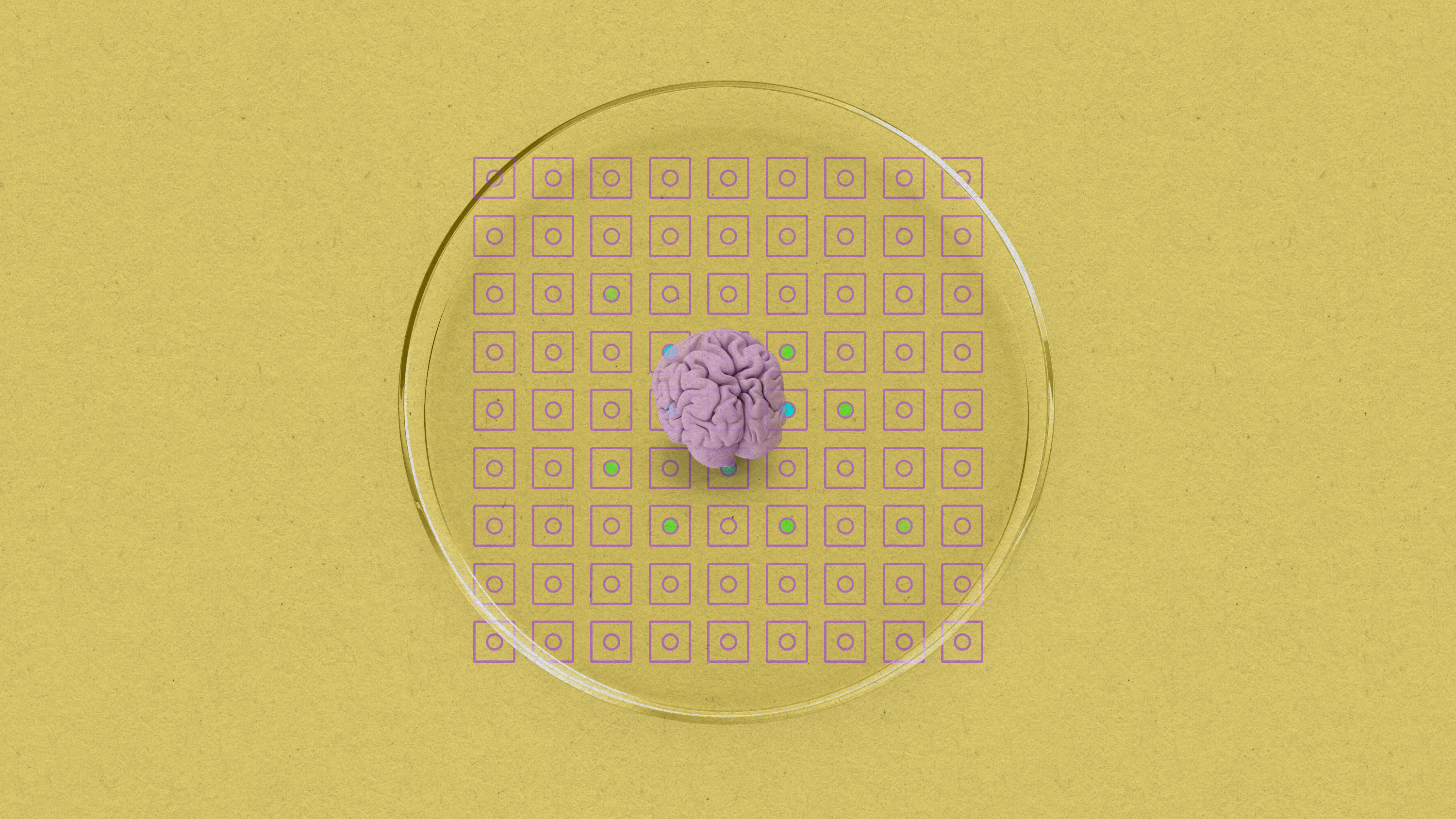
Brain organoids, clumps of human brain cells grown in a dish, can be hooked up to an electronic chip and carry out simple computational tasks, a new study shows.
Feng Guo and his team at Indiana University Bloomington generated a brain organoid from stem cells, attached it to a computer chip, and connected their setup, known as Brainoware, to an AI tool. They found that this hybrid system could process, learn, and remember information. It was even able to carry out some rudimentary speech recognition. The work, published today in Nature Electronics, could one day lead to new kinds of bio-computers that are more efficient than conventional computers.
Scientists have been trying to build computers based on advanced biological systems for decades. Guo says that such computers could overcome some challenges of silicon-based computers, such as bottlenecks in data processing.
Conventional computers are much better than brains in dealing with numbers, but human brains are better at processing complex information while using relatively little energy. “This is a first demonstration of using brain organoids [for computing],” says Guo. “It’s exciting to see the possibilities of organoids for biocomputing in the future.”
With Brainoware, Guo aimed to use actual brain cells to send and receive information. When the researchers applied electrical stimulation to the hybrid system they’d built, Brainoware responded to those signals, and changes occurred in its neural networks. According to the researchers, this result suggests that the hybrid system did process information, and could perhaps even perform computing tasks without supervision.
Guo and his colleagues then attempted to see if Brainoware could perform any useful tasks. In one test, they used Brainoware to try to solve mathematical equations. They also gave it a benchmark test for speech recognition, using 240 audio clips of eight people pronouncing Japanese vowels. The clips were converted into electrical signals and applied to the Brainoware system. This generated signals in the neural networks of the brain organoid, which were then fed into an AI tool for decoding.
The researchers found that the brain organoid–AI system could decode the signals from the audio recordings, which is a form of speech recognition, says Guo. “But the accuracy was low,” he says. Although the system improved with training, reaching an accuracy of about 78%, it was still less accurate than artificial neural networks, according to the study.
Lena Smirnova, an assistant professor of public health at Johns Hopkins University, points out that brain organoids do not have the ability to truly hear speech but simply exhibit “a reaction” to pulses of electrical stimulation from the audio clips. And the study did not demonstrate whether Brainoware can process and store information over the long term or learn multiple tasks. Generating brain cell cultures in a lab and maintaining them long enough to perform computations is also a huge undertaking.
Still, she adds, “it’s a really good demonstration that shows the capabilities of brain organoids.”
Deep Dive
Computing
Future AI chips could be built on glass
A specialized glass layer could make tomorrow’s computers faster and more energy efficient.
Can quantum computers now solve health care problems? We’ll soon find out.
After 30 months of fast-paced innovation in quantum algorithms, six research groups are hoping to hit paydirt. But there can be only one big winner—if there is a winner at all.
Welcome to the dark side of crypto’s permissionless dream
Jean-Paul Thorbjornsen is a leader of THORChain, a blockchain that is not supposed to have any leaders—and is reeling from a series of expensive controversies.
All blocks story test – Standard
Lorem ipsum dolor sit amet, consectetur adipiscing elit, sed do eiusmod tempor incididunt ut labore et dolore magna aliqua.
Stay connected
Get the latest updates from
MIT Technology Review
Discover special offers, top stories, upcoming events, and more.